
🕵️How to Find Stocks With Insider Buying (Signal vs Noise)
How to Find Stocks With Insider Buying
When a manager or director buys shares of their own company with their own money, they're sending a quiet message: I believe this is going up. Nobody knows a business better than its leadership. That's why insider buying is one of the cleaner "smart money" signals. But beware — not every buy is a signal. Here's how to separate the wheat from the chaff, and find it fast.
In short
- An insider = a company executive (director, officer, large shareholder).
- Their trades must be reported to the SEC and are public — via Form 4.
- Cash buys outweigh option exercises; several insiders at once beats one.
- The strongest buy is confirmed by other layers (fundamentals, funds) = confluence.
🔰 In plain words (for beginners)
Picture a head chef who, after their shift, orders their own dish twice and pays out of pocket. That's a different message than a waiter just tasting it. And if two sous-chefs join in — it's clear: they trust this kitchen.An insider buy is exactly that "second helping". The boss buys their own stock with their own cash. And when several executives buy at once, it's a much louder signal than one small purchase.
What "insider buying" means and what Form 4 is
In the U.S., insiders (officers, directors, large shareholders) must report trades to the SEC on Form 4, usually within two business days. These filings are public. A cluster of insiders buying — especially open-market, cash purchases rather than option exercises — is often read as a vote of confidence.But raw Form 4 data is noisy. Not every buy means something, and a single buy tells you little.
Signal vs noise — what to actually weigh
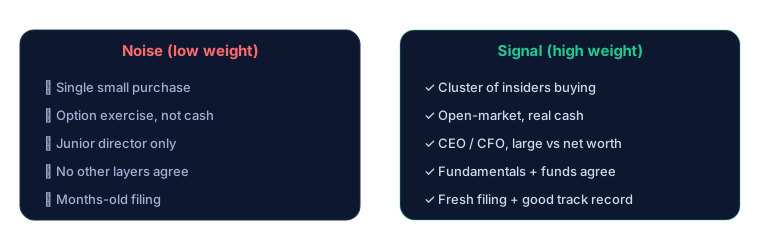
| More noise (low weight) | More signal (high weight) |
|---|---|
| A single small purchase | A cluster of insiders buying at once |
| Option exercise, not cash | Open-market buy with real money |
| Junior director only | CEO/CFO, large vs their net worth |
| No other layer agrees | Fundamentals and funds agree too |
| Months-old filing | Fresh filing + good insider track record |
🎯 For pros
Weight by transaction type, seniority, size vs the person and cluster density within a window. Then condition on the insider's 90-day historical hit rate and look for confirmation from 13F adds. A lone Form 4 is a data point; a weighted cluster with a good record and cross-confirmation is a thesis input.Step by step
- Filter to cash buys (not option exercises).
- Look for clusters — several insiders in a short window.
- Weight by role and size relative to the person.
- Confirm with fundamentals/funds — seek confluence.
- Prefer fresh filings and insiders with a good record.
💡 What this means for you
You don't need insider information — just the skill to read the public kind. Learn to tell a strong insider buy (cluster, cash, context) from a random one, and you hold a signal most people overlook or misread.Mini-glossary
- Insider — a company officer, director or large shareholder.
- Form 4 — the public SEC filing of an insider's trade (within ~2 days).
- Open-market buy — the insider bought shares with real money on the exchange (stronger signal).
- Cluster — several insiders buying in a short time.
- Confluence — the insider signal agreeing with other layers.
Try it in QMA
QMA's Insider Monitoring shows, for each signal, who bought, when (exact dates), the buy size vs the company (weight %), a buys-vs-sells chart, and the insider's 90-day track record. That layer then feeds the Smart Money and overall score. Open a free complete analysis of NVDA and see how the insider layer sits in the whole.FAQ ### What is SEC Form 4? The form an insider uses to report a trade to the SEC, usually within two business days. The data is public. ### Is insider buying a reliable signal? It's a signal, not a guarantee — most useful in context (clusters, cash buys, confirmation from other layers). ### How does QMA score insider buying? It shows who, when, size vs the company (weight %), buys-vs-sells and a 90-day record, then folds it into the Smart Money and composite score.
Past performance ≠ future results. QMA is not a registered investment advisor.
Want to know more? Ask the QMA Research Assistant
The Research Assistant knows the whole platform and its data. If the answer is not in the QMA database, it looks it up and explains it in plain language. It is an analytical and educational tool, not investment advice.
Open the Research Assistant →Related articles
Když instituce nakupují nebo prodávají miliardové pozice, dělají to potichu a rozloženě — ale úplně neviditelní nejsou. Ukazujeme, jaké stopy v datech hledat a proč je to vždy jen pravděpodobnost, ne jistota.
6 minVysoký short interest zní jako tajná stopa chytrých peněz. Někdy je to varování, jindy palivo pro raketu. A často jen šum. Rozebíráme to na číslech.
6 minNeobvyklý objem, tučná prémie, nakloněný poměr call/put — options flow vypadá jako detektivní stopa po chytrých penězích. Vysvětlujeme mechaniku, ukazujeme konkrétní příklad i to, proč stejná stopa může znamenat spekulaci i zajištění. Bez mýtů, bez slibů směru.
5 minAmeričtí zákonodárci musí ze zákona hlásit své obchody s akciemi – a internet z toho udělal sport sledovat, co kupuje Nancy Pelosi. Vysvětlujeme, co ta data skutečně říkají, kde je zpoždění a proč to není recept na jistý zisk.
5 minSee it live: QMA scores 17,000+ stocks for you
Full access to the 5-pillar analysis, smart-money data and the whole-market screener. No commitment, cancel anytime.
QMA Brain – free weekly recap
One email a week with a descriptive recap. Unsubscribe anytime.
7 days of Elite free, no card
The account is free to open and needs no card. For that time the account has full Elite access.
Create a free accountContent created by AI in collaboration with Jaroslav Vojtášek. Not investment advice. The author may hold the stocks mentioned. Investing involves risk of loss.
Operator: Jaroslav Vojtášek, Company ID (IČO) 48783447.