
🧠What Is "Smart Money" and How to Follow It (Beginner's Guide)
What Is "Smart Money" and How to Follow It
Not all players on the market are equal. Some have more information, more capital and more experience than the average retail investor. They're called "smart money" — and the best part: their trades are often public. This guide explains who they are, where they leave a trail, and how to turn that trail into a useful score instead of random tips.
In short
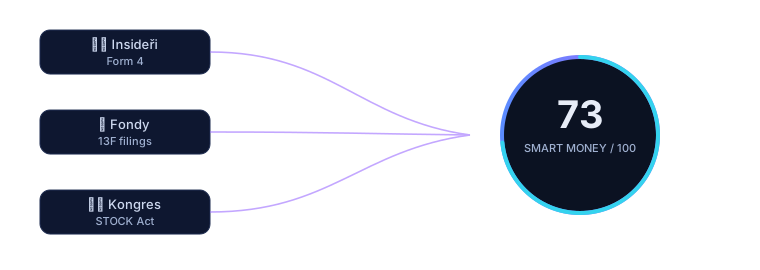
- Smart money = insiders (company executives), big funds, and politicians (U.S. Congress).
- Their trades are disclosed by law — you can follow them legally and free.
- No single source is enough — the edge is in their agreement (confluence).
- The data is delayed — it's not an early tip, it's pattern analysis.
🔰 In plain words (for beginners)
Think of weather. One forecast can be wrong. But when three independent stations all predict rain, you grab an umbrella — because agreement across sources is more reliable.Following smart money is the same. When a company's boss buys a stock and a big fund buys it and a politician adds it too, that's a stronger trail than any one alone. You're not guessing — you're watching where the "smart money" overlaps.
Three sources of smart money
| Source | What it is | Why follow it |
|---|---|---|
| Insiders (Form 4) | Buys by company executives | They know the business best, buying their own cash |
| Funds (13F) | Big institutions' positions | Large capital + teams of analysts |
| Congress (STOCK Act) | U.S. politicians' trades | Often close to information and capital |
- Form 4 — the form an insider uses to report a trade to the SEC, usually within 2 days. Public.
- 13F — a quarterly report from big funds on what they hold.
- STOCK Act — a 2012 law; politicians must disclose trades over $1,000 within 45 days.
Why one source isn't enough
A single insider buying a few shares may have a hundred private reasons. So might one politician. A lone signal is noise. Only when independent sources agree on the same stock at the same time does a signal emerge.That's confluence — the heart of the approach. The goal isn't to copy one trade, but to see where several independent trails converge.
🎯 For pros
Treat smart money as a low-frequency, lagged input, not standalone alpha. Weight by transaction type (cash buy > option exercise), size vs the person, cluster density over time, and seniority (CEO/CFO > junior director). Condition on the insider's historical hit rate and require cross-layer confirmation (13F adds, momentum). Naive mirroring is structurally weak because of the disclosure delay.Step by step
- Don't watch one feed. A single insider or politician is noise — look for agreement.
- Add context. Pair smart money with fundamentals, momentum and seasonality.
- Measure, don't guess. Turn the trail into a 0–100 score so you can compare stocks.
- Mind the delay. The data is public and lagged — never copy blindly.
💡 What this means for you
You don't need a "tip from a friend at a bank". Public data shows where the money of people who know companies best overlaps. Read in context (not as a single headline), it's an edge most retail investors never use.Mini-glossary
- Smart money — insiders, funds and politicians; players with more info and capital.
- Insider — a company executive; their trades are public (Form 4).
- 13F — a quarterly report of big funds' positions.
- Confluence — agreement of several independent signals on the same stock.
Try it in QMA
QMA fuses insiders, funds and Congress into one Smart Money score (0–100), which feeds the overall score across all 13 layers. Open a free complete analysis of AAPL and see how the Smart Money layer sits inside the full picture.FAQ
Is following smart money legal?
Yes. Insider (Form 4), fund (13F) and Congress (STOCK Act) data are public, mandatory disclosures.Can I just copy what they buy?
Not blindly — the data is delayed and lacks context. Better to watch agreement across sources. It's not advice.How does QMA build the Smart Money score?
It fuses insiders, funds and Congress into one 0–100 number that's part of the composite score across 13 layers.Past performance ≠ future results. QMA is not a registered investment advisor.
Want to know more? Ask the QMA Research Assistant
The Research Assistant knows the whole platform and its data. If the answer is not in the QMA database, it looks it up and explains it in plain language. It is an analytical and educational tool, not investment advice.
Open the Research Assistant →Related articles
Když instituce nakupují nebo prodávají miliardové pozice, dělají to potichu a rozloženě — ale úplně neviditelní nejsou. Ukazujeme, jaké stopy v datech hledat a proč je to vždy jen pravděpodobnost, ne jistota.
6 minVysoký short interest zní jako tajná stopa chytrých peněz. Někdy je to varování, jindy palivo pro raketu. A často jen šum. Rozebíráme to na číslech.
6 minNeobvyklý objem, tučná prémie, nakloněný poměr call/put — options flow vypadá jako detektivní stopa po chytrých penězích. Vysvětlujeme mechaniku, ukazujeme konkrétní příklad i to, proč stejná stopa může znamenat spekulaci i zajištění. Bez mýtů, bez slibů směru.
5 minAmeričtí zákonodárci musí ze zákona hlásit své obchody s akciemi – a internet z toho udělal sport sledovat, co kupuje Nancy Pelosi. Vysvětlujeme, co ta data skutečně říkají, kde je zpoždění a proč to není recept na jistý zisk.
5 minSee it live: QMA scores 17,000+ stocks for you
Full access to the 5-pillar analysis, smart-money data and the whole-market screener. No commitment, cancel anytime.
QMA Brain – free weekly recap
One email a week with a descriptive recap. Unsubscribe anytime.
7 days of Elite free, no card
The account is free to open and needs no card. For that time the account has full Elite access.
Create a free accountContent created by AI in collaboration with Jaroslav Vojtášek. Not investment advice. The author may hold the stocks mentioned. Investing involves risk of loss.
Operator: Jaroslav Vojtášek, Company ID (IČO) 48783447.